The 75-country policy is an indefinite pause on issuing immigrant visas at consulates abroad to nationals of those countries; it does not by itself bar entry on nonimmigrant visas, revoke existing immigrant visas or green cards, or force people inside the U.S. to leave.
Core scope of the 75-country pause
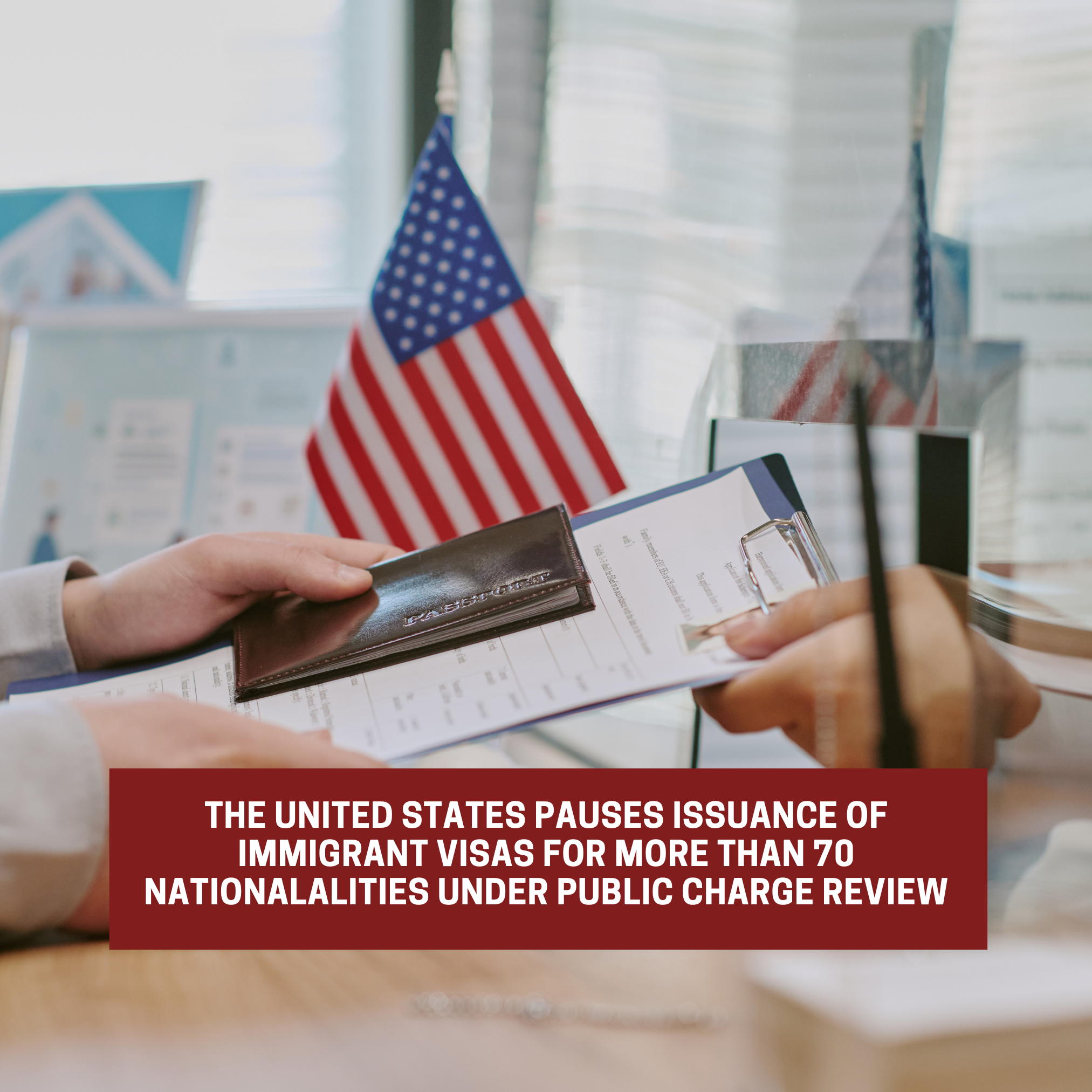
• Effective January 21, 2026, the Department of State (DOS) will not issue immigrant visas (i.e., visas leading to permanent residence) to applicants who are nationals of 75 designated countries, based on an asserted reassessment of public-charge screening.
• The pause applies to all immigrant visa categories processed at consulates (family-based, employment-based, diversity, some special immigrant categories) where the applicant is a national of a listed country, regardless of where they are residing.
• Applicants may still submit DS-260s, pay fees, and attend interviews, but consular officers are instructed not to print or issue immigrant visas to affected nationals while the pause remains in effect.
You may also read. “Department of State pauses immigrant visas for nationalities with high public charge risk”
What is not covered
• The pause does not apply to nonimmigrant visas (B-1/B-2, F-1, J-1, H-1B, etc.), although consular officers may apply heightened public-charge and security review to those cases.
• It does not affect adjustment of status inside the United States; USCIS may still adjudicate I-485s filed domestically, though nationals of these countries may also be subject to the separate USCIS adjudication pauseand public-charge holds now applied to 39+ countries.
• The policy does not revoke immigrant visas that were already issued, and does not cancel existing lawful permanent residence for people who already entered with an immigrant visa.
You may also read.
Key exceptions
• Dual nationals using a non-listed passport: A dual national of a listed and a non-listed country who applies with a valid passport from a non-listed country is expressly exempt from the pause for that application.
• Nonimmigrant visas: All nonimmigrant categories remain legally available (subject to background, security, and any pre-existing travel bans) because the pause text is limited to “immigrant visas.”
• People already in the U.S.: DOS and university advisories clarify that the pause “does not require anyone to depart the United States” and does not directly apply to people adjusting status in the U.S., though they face increased public-charge scrutiny and should avoid consular processing where possible.
Relationship to other bans and pauses
• For several of the 75 countries, earlier travel bans and security-based proclamations (e.g., P.P. 10949, 10998) already impose separate limits on certain immigrants and nonimmigrants; those regimes continue in parallel.
• Separately, USCIS has announced an internal adjudication hold on many benefit applications for nationals of overlapping “high-risk” countries, with narrow exceptions (document replacement, some work authorization, certain naturalization and certificate cases, national-interest cases, etc.), which can delay green-card and other benefits even for people inside the U.S.
If you indicate the scenario (e.g., spouse of a U.S. citizen consular-processing abroad vs. employment-based adjustment already filed inside the U.S.), the practical impact and any available workaround (dual-national passport strategy, switching to adjustment, timing of travel) can be analyzed very specifically.
On November 28, 2025, the US president wrote in a Truth Social post that this would “allow the US system to fully recover” from policies that had eroded the “gains and living conditions” of many Americans.
‘Third-world countries’
In the post, the president also blamed refugees for causing the “social dysfunction in America” and vowed to remove “anyone who is not a net asset” to the US.
- “I will permanently pause migration from all Third World Countries to allow the U.S. system to fully recover,” the president wrote.
- “I will
- permanently pause migration
- from all Third World Countries
- to allow the U.S. system to fully recover,”
- the president wrote. [on Truth Social]
The president had already imposed a travel ban on nationals of Afghanistan – and 11 other countries, primarily in Africa and Asia – earlier this year. Another travel ban targeting a number of majority-Muslim countries was enacted during his first term.
Overview of the Announcement
On November 28, 2025, President Donald Trump announced via a Truth Social post a “permanent pause” on migration from “all Third World Countries” to allow the U.S. immigration system to “fully recover” from prior policies and address national security concerns. This statement followed the fatal shooting of a National Guard member in Washington, D.C., by an Afghan national, which the administration cited as a catalyst for heightened scrutiny. The announcement builds on a January 2025 travel ban (Proclamation under Executive Order 14161) that fully suspended entry from 12 countries (e.g., Afghanistan, Iran, Libya, Somalia, Sudan, Yemen) and imposed partial restrictions on seven others (e.g., Burundi, Cuba, Laos, Sierra Leone, Togo, Turkmenistan, Venezuela), totaling 19 “countries of concern” based on inadequate vetting or security risks.
The Department of Homeland Security (DHS) and U.S. Citizenship and Immigration Services (USCIS) clarified that the pause targets these 19 nations, described euphemistically as “Third World” in Trump’s rhetoric, rather than a literal blanket ban on over 100 low-income countries. It suspends new immigrant and nonimmigrant visas, halts green card processing, and mandates a “rigorous reexamination” of existing green cards for affected holders, with potential revocations for those deemed security risks. Exceptions apply to diplomats, certain U.S. military allies, and immediate family reunifications under limited circumstances. Implementation is immediate, effective November 28, 2025, pursuant to Section 212(f) of the Immigration and Nationality Act (INA), 8 U.S.C. § 1182(f), which grants the President broad authority to restrict entry when detrimental to U.S. interests.
Civil rights groups, including the ACLU and National Immigration Law Center (NILC), filed lawsuits in the U.S. District Courts for the Northern District of California and Southern District of New York within hours, seeking preliminary injunctions. As of November 28, 2025, no stays have been issued, but experts anticipate rapid escalation to appellate courts.
Legal Framework and Precedent
The ban’s constitutionality hinges on the President’s plenary power over immigration, a doctrine rooted in the political branches’ authority to regulate foreign affairs, as affirmed in cases like Chae Chan Ping v. United States (Chinese Exclusion Case), 130 U.S. 581 (1889), and Fong Yue Ting v. United States, 149 U.S. 698 (1893). These establish that immigration decisions are largely insulated from judicial review, provided they do not violate core constitutional protections.
The operative authority is INA § 212(f), which states: “Whenever the President finds that the entry of any aliens or of any class of aliens into the United States would be detrimental to the interests of the United States, he may by proclamation, and for such period as he shall deem necessary, suspend the entry of all aliens or any class of aliens as immigrants or nonimmigrants, or impose
on the entry of aliens any restrictions he may deem to be appropriate.” This provision was invoked for Trump’s 2017-2018 travel bans and upheld by the Supreme Court.
Key Precedent: Trump v. Hawaii, 585 U.S. 667 (2018)
In a 5-4 decision, Chief Justice John Roberts upheld the third iteration of Trump’s “Muslim Ban” (Proclamation 9645), restricting entry from several Muslim-majority countries. The Court applied rational basis review—the lowest scrutiny level—deferring to the President’s national security findings under § 212(f). Roberts emphasized: “The President has lawfully exercised the broad discretion granted to him under § 1182(f) to suspend the entry of aliens into the United States” because the proclamation was “expressly premised on legitimate purposes” like protecting against terrorism, despite campaign statements suggesting religious animus.
The dissent (Justice Sonia Sotomayor, joined by Ginsburg) argued the ban violated the Establishment Clause (U.S. Const. amend. I) by disfavoring Islam, but the majority dismissed extrinsic evidence of intent, focusing on the facially neutral policy. This precedent directly bolsters the 2025 ban, as it too cites security risks (e.g., the D.C. shooting) and targets countries based on vetting deficiencies, not explicit religion or race.
Arguments For Upholding the Ban
1. Broad Executive Authority Under § 212(f): The statute’s text is unambiguous, granting unilateral power without requiring congressional approval or detailed evidence. Courts have historically deferred to such proclamations, as in Sale v. Haitian Centers Council, Inc., 509 U.S. 155 (1993), where the Court upheld extraterritorial restrictions on Haitian refugees. The June 2025 ban’s expansion to 19 countries was similarly justified by reports of inadequate passport controls and terrorism risks, mirroring Trump v. Hawaii’s reliance on executive findings.
2. National Security Rationale: The administration links the pause to the Afghan suspect’s case, invoking the same “detrimental interests” language as in prior bans. In Dep’t of Homeland Sec. v. Regents of the Univ. of Cal., 140 S. Ct. 1891 (2020) (DACA case), the Court scrutinized procedural flaws but reaffirmed deference to security-based immigration actions. With a 6-3 conservative Supreme Court majority (as of 2025), including Trump appointees, rational basis review would likely apply, requiring only a conceivable security link—which exists here.
3. No Retroactive Impact on Lawful Permanent Residents (LPRs): The green card review is framed as administrative vetting under INA § 237(a), 8 U.S.C. § 1227, not automatic revocation. Zadvydas v. Davis, 533 U.S. 678 (2001), protects LPRs’ due process rights (Fifth Amendment), but targeted reviews for fraud or security threats are permissible if individualized, as upheld in INS v. Lopez-Mendoza, 468 U.S. 1032 (1984).
4. Recent Judicial Trends: Lower courts enjoined early 2017 bans for procedural irregularities (e.g., Washington v. Trump, 847 F.3d 1151 (9th Cir. 2017)), but the revised version survived. The 2025 iteration avoids those pitfalls by building on the vetted June proclamation. A Forbes analysis
notes that while Trump’s broader agenda faces setbacks (e.g., birthright citizenship EO struck down in New Hampshire v. Trump, No. 25-cv-00123 (D.N.H. July 24, 2025)), targeted entry suspensions fare better.
Upholders argue the ban aligns with congressional intent in the INA and fulfills the President’s Article II foreign affairs powers.
Arguments Against the Ban (Potential for Overturn)
1. Discriminatory Animus and Equal Protection: Critics contend the “Third World” label and 19- country list (disproportionately African, Middle Eastern, and Latin American) evidence racial/national origin bias, violating the Fifth Amendment’s equal protection component (Bolling v. Sharpe, 347 U.S. 497 (1954)). NILC lawsuits cite Trump’s Truth Social post’s inflammatory rhetoric (e.g., blaming migrants for “social dysfunction”) as extrinsic evidence of pretext, akin to the 2017 campaign’s “Muslim ban” statements. If strict scrutiny applies (requiring a compelling interest and narrow tailoring), the ban’s breadth—suspending even nonimmigrant visas—may fail, as in Regents where rescission was deemed arbitrary.
2. Establishment Clause Concerns: Though not overtly religious, the list includes Muslim majority nations (e.g., Yemen, Sudan), potentially signaling disfavor for Islam in violation of Church of Lukumi Babalu Aye v. City of Hialeah, 508 U.S. 520 (1993). Al Jazeera reports highlight family separation impacts, arguing it burdens protected associational rights (Moore v. City of East Cleveland, 431 U.S. 494 (1977)).
3. Due Process for LPRs and Procedural Flaws: Reexamining green cards risks retroactive deprivation without hearings, contravening Reno v. Flores, 507 U.S. 292 (1993). The ACLU argues the announcement’s haste (issued Thanksgiving night) lacks reasoned explanation, inviting State Farm Mut. Auto. Ins. Co. v. Dep’t of Transp., 463 U.S. 29 (1983) arbitrary-and-capricious review under the Administrative Procedure Act (APA), 5 U.S.C. § 706.
4. Overbreadth and INA Conflicts: The pause may infringe INA refugee provisions (8 U.S.C. § 1157) or family-based immigration (8 U.S.C. § 1151), as partial bans already limit reunifications. Legal experts in Legal Not Legal predict challenges under the non-delegation doctrine if § 212(f) is deemed an unlimited grant of power (Gundy v. United States, 588 U.S. 128 (2019) (plurality)).
Litigation history shows early injunctions in liberal circuits (9th and 2nd), but Supreme Court reversal, as in Trump v. Hawaii.
Likelihood of Uphold vs. Overturn
The ban is likely to be upheld by the federal courts, particularly at the Supreme Court level, with a 70-80% probability based on Trump v. Hawaii‘s binding precedent and the current 6-3 conservative majority. Lower courts may issue temporary injunctions (40-50% chance in the 9th Circuit), delaying implementation for months, as seen in 2017. However, the facially neutral security rationale—tied to a specific incident—and § 212(f)’s deference would probably prevail
under rational basis review. Overturn risks rise if evidence of racial animus dominates (e.g., via discovery of internal memos) or if the green card reviews trigger mass due process violations, potentially leading to a narrow 5-4 reversal on those grounds.
This analysis assumes no major procedural amendments; ongoing suits will clarify scope. For affected individuals, consulting immigration counsel is urgent, as waivers remain available for case-by-case hardships.
________
The new ban takes effect as of 12:01am EST on January 1, 2026, and as with the June 4th travel bans, it provides for a full suspension on entry for nationals of some countries, and a partial restriction for others.
Full Travel Ban: The full bans suspend entry to the United States on both immigrant and nonimmigrant visas.
The new ban continues the full suspension of entry for nationals from the following countries:
- Afghanistan
- Burma (Myanmar)
- Chad
- Republic of the Congo
- Equatorial Guinea
- Eritrea
- Haiti
- Iran
- Libya
- Somalia
- Sudan
- Yemen
• The new ban adds the following countries to the full suspension on entry:
- Burkina Faso
- Laos
- Mali
- Niger
- Sierra Leone
- South Sudan Syria
o It also includes individuals using travel documents issued or endorsed by the Palestinian Authority (PA).
Partial Travel Ban: The partial bans restrict entry to the United States on B-1, B-2, B-1/B-2, F, M, and J visas, and reduces the validity of other nonimmigrant visas (presumably to reciprocity schedule minimums).
• The new ban continues the partial suspension on entry for nationals of: o Burundi
- Cuba
- Togo
- Venezuela
• The new ban adds the following countries to the partial suspension on entry:
- Angola
- Antigua and Barbuda
- Benin
- Cote d ‘Ivoire
- Dominica
- Gabon
- The Gambia
- Malawi
- Mauritania
- Nigeria
- Senegal
- Tanzania
- Tonga
- Zambia
- Zimbabwe
The new ban removes Turkmenistan from the Partial Travel Ban list for purposes of nonimmigrant visas but continues the ban on nationals of Turkmenistan entering the United States using immigrant visas.
Scope:
• Only applies to those outside the U.S. as of 12:01am EST on January 1, 2026, and do not have a valid visa as of that date.
• Does not apply to:
o Lawful permanent residents of the U.S.
o Any dual nationals of a listed country when the individual is traveling on a passport issued by a country not subject to the travel ban. o Any foreign national traveling on the following visas: A 1, A-2, C-2, C-3, G-1, G 2, G-3, G-4, NATO-1, NATO 2, NATO-3, NATO-4, NATO-5, or NATO-6. o Athletes, coaches, those in supporting roles, and immediate relatives, traveling for the World Cup, Olympics, or other major sporting event as determined by the Secretary of State.
o Special Immigrant Visas for U.S. Government employees.
o IVs for ethnic and religious minorities facing persecution in Iran.
o Individuals granted asylum and refugees previously admitted to the U.S.
Removed Exceptions: The new ban eliminates the following categorical exceptions from the June 4th Proclamation:
• Immigrant visas for family members in the U.S.
• Adoptions (IR-3, IR-4, IH-3, IH-4)
• Afghan Special Immigrant Visas National Interest Exceptions: The new ban provides for exceptions in the national interest based on a determination by the Attorney General, Secretary of State or Secretary of Homeland Security.
By: Doctor Alexander Alfano
For more information on these topics, visit Paralegal Clases’ social media pages and join our live sessions every Wednesday.
Instagram: @Paralegalclases
Facebook: Instituto Paralegal de las Américas
Youtube: Instituto Paralegal
Tiktok: @Paralegalnews